
A pre-visit communication framework for veterinary practices, from Alphaeon with insights from Debbie Boone, CVPM, and Gigi Santos, LCSW, of Not One More Vet.
Executive summary
Veterinary practices can protect patient outcomes, client trust and team well-being by preparing pet parents for the cost of care before they arrive, not at checkout.
Rising fees, falling visit numbers and stretched household budgets make this urgent. This paper explains why cost conversations get avoided, what that costs clients and teams, and offers a three-stage framework and checklist practices can adopt now.
1. The problem: an expectation gap meets a strained budget
Pet parents underestimate the cost of care, and their budgets have little room to absorb the surprise.
Clients don't know what care costs
Research by Dr. Karen Felsted found owners estimated exam and vaccine costs fairly accurately, but expected a dental cleaning to cost about $55. A grade 1 dental today can exceed $650. Most clients also know little about anatomy or disease, so explanations that assume basic knowledge can leave them confused and defensive.
Online information doesn't close the gap. An AI query for a routine visit in Greensboro, North Carolina returned exam fees, vaccine ranges and clinic prices where a single vaccine varied by more than double. A client facing that spread is more likely to delay than to decide.
Households are stretched
| Indicator | Figure cited in the webinar |
|---|---|
| U.S. household debt | About $18.8 trillion |
| Americans living paycheck to paycheck | One-third to two-thirds, depending on the survey |
| Would need to borrow for a $1,000 emergency | 43% |
| Typical routine visit invoice | Over $200 |
| Lifetime cost of ownership (all-inclusive) | Up to $60,000 for a dog; over $47,000 for a cat |
Practices are feeling it
Economist Dr. Matt Salois describes a "veterinary recession": visits decline while revenue rises slightly on higher fees. Practices report open appointments that were unheard of two years ago. Loyal clients are moving to vaccine clinics, shelters and feed stores, or waiting to see if a symptom passes.
The downstream pattern is consistent across downturns: preventive care is deferred, urgent cases rise, and relinquishment and economic euthanasia increase.
2. Root causes: why cost conversations get delayed
Practices routinely discuss diet, training, dental care and harnesses. Cost is the topic most often left until circumstances force it.
| Barrier | How it shows up |
|---|---|
| Cultural discomfort | Talking about money feels rude or greedy; teams fear sounding like a pushy salesperson. |
| No formal training | Few team members have been taught how to discuss finances or explain the value behind a fee. |
| The timing trap | Too early feels insensitive; too late leaves the client blindsided and distrustful. |
| Fear of rejection | A declined estimate feels like failing the doctor and the patient. |
| Under-informed front desk | CSRs field cost questions without the medical context to answer them, so questions get bounced between staff. |
| Restrictive policies | Some practices refuse to quote even routine prices by phone, which reads to clients as hiding something. |
| Rushed appointments | Education takes time; a five-minute visit leaves none for it. |
Boone's reframe is the starting point for change: "Talking about money is part of patient care, and you cannot separate the two."
3. The human impact on clients and teams
Uncertainty about cost raises emotional intensity on both sides of the exam table, and that intensity degrades care and communication.
For pet parents
Even routine visits carry low-level fear: the doctor might find something unexpected, or the pet's weight or age might prompt guilt. Unknown costs compound it. In emergencies, Boone describes clients in a "limbic hijack" so intense that the team cannot take an accurate history. Clients who aren't told about fees often don't object in the moment. They pay, then tell friends how expensive the visit was, eroding the word-of-mouth that builds "raving fans."
For veterinary teams
Santos frames client education as a workforce well-being strategy. When teams lack answers or resources for financial conversations, NOMV sees:
anxiety before and during cost discussions;
discomfort and avoidance around particular clients;
moral distress when care must be declined or euthanasia is chosen for financial reasons;
cumulative stress that contributes to burnout and turnover.
The reverse is also true. Santos, an owner of five pets including a Boston Terrier with a seizure disorder, describes how preparing for visits lowered her own emotional intensity, and her care team's. Prepared clients communicate more clearly, slow down, and make decisions with less conflict. That protects team workflow and makes healthy boundaries easier to hold.
4. The framework: three stages of cost communication
Cost communication works best as a continuous practice that begins before the client arrives, not a single conversation at checkout.
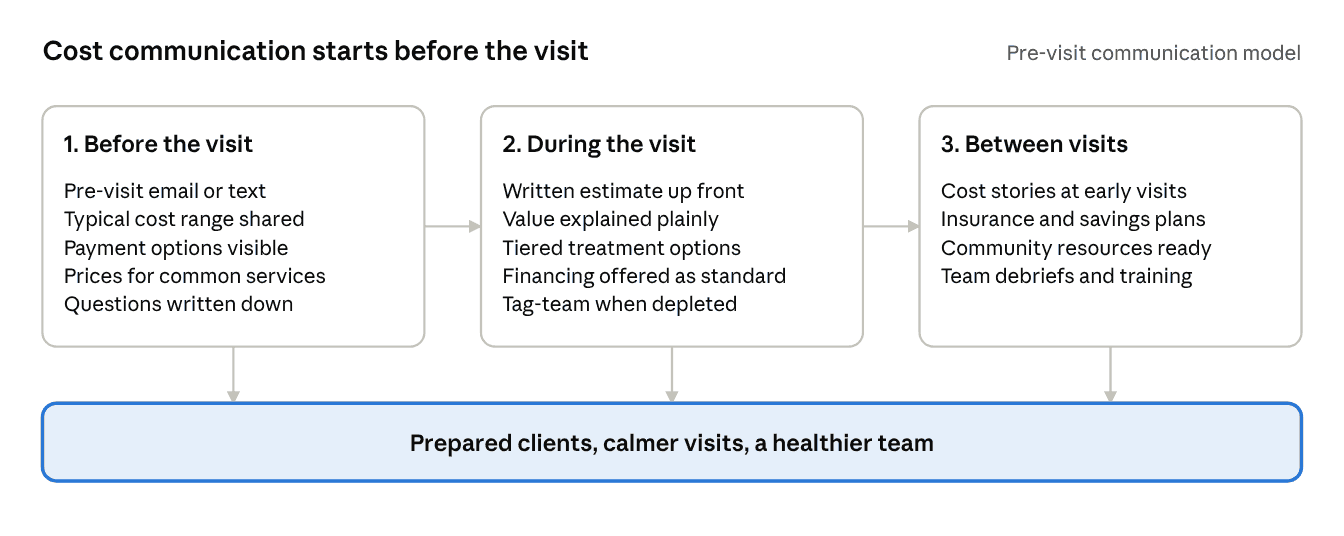
Each stage lowers uncertainty for the next. A client who received a cost range before the visit hears the estimate as confirmation, not shock. A client who heard cost stories at a puppy visit is more likely to have insurance, savings or a financing plan when an emergency comes.
5. Implementation checklist
Practices can adopt most of these steps within a quarter, without new technology.
Before the visit
☐ Add a pre-visit email or text template: records and medication list, written questions, arrive early, bring leash or carrier, flag an anxious pet.
☐ Include the typical cost range for the scheduled service in that message.
☐ List every accepted payment and financing option on the website, social profiles, reminders and handouts.
☐ Decide whether to publish prices for common services, each with what is included and why.
☐ Allow trained team members to quote routine prices by phone.
During the visit
☐ Present written estimates before treatment, without the client having to ask.
☐ Explain value in plain language; avoid assuming medical knowledge.
☐ Offer tiered treatment options when gold-standard care is out of reach.
☐ Present financing as a standard option, not a last resort.
☐ Use a tag-team or handoff when a team member is depleted.
Across the relationship
☐ Share real cost stories at puppy and kitten visits to encourage insurance and savings.
☐ Train front-desk staff on common diagnoses and the value of core services.
☐ Keep a current list of community partners and charitable funds.
☐ Debrief after difficult cases, and celebrate wins.
☐ Schedule appointments long enough for education.
Payment-option toolkit
No single tool fits every client. Practices should be ready to discuss each.
| Option | Best for | Note |
|---|---|---|
| Patient financing (e.g., Alphaeon) | Planned procedures and unexpected costs | Promotional terms such as 24 months no interest if paid in full, with longer terms up to 60 months, subject to credit approval |
| Pet insurance | Large, unpredictable costs over the pet's life | Most valuable when enrolled young |
| Wellness or savings plans | Routine and preventive care | Spreads predictable costs across the year |
| Traditional credit cards | Smaller balances | Interest may apply |
| Charitable funds (e.g., Veterinary Care Foundation) | Clients who don't qualify for other options | Some practices also arrange donor-client support funds |
| Alternative treatment plans | When gold-standard care is unaffordable | Still provides relief for the patient |
6. Measuring success
Track a small set of indicators before and after adopting the framework:
Client: estimate acceptance rate, routine visit volume and preventive-care compliance, online reviews mentioning cost or communication.
Financial: financing application volume, share of invoices paid in full at checkout, accounts receivable.
Team: staff turnover, self-reported stress around financial conversations, and baseline-to-follow-up results from a well-being assessment such as NOMV's Clear Blueprint certification.
7. Conclusion
Client trust is a practice's most valuable asset, and it is built by being forthcoming about the reality of pet care, including its cost. The practices that thrive through this downturn will treat the cost conversation not as an awkward afterthought, but as part of the standard of care.
About the contributors
Debbie Boone, CVPM, owner of Debbie Boone Consulting, has worked in veterinary hospitals since 1985 and helps practices improve operations and client experience.
Gigi Santos, LCSW, is CEO of Not One More Vet, a global nonprofit founded in 2014 to support mental health and well-being in the veterinary profession. Free resources are available at nomv.org.
Rafael Velasco of Alphaeon moderated the webinar.
About Alphaeon: Alphaeon provides patient financing that helps veterinary practices offer flexible payment options, so more pet parents can say yes to the care their pets need.
Sources
Figures in this paper are as cited by the speakers during the Alphaeon webinar "Pause and Peace of Mind: Helping Pet Parents Prepare for Cost Before the Visit." They include research by Dr. Karen Felsted on owner cost perceptions, commentary by economist Dr. Matt Salois, and national consumer-finance surveys. Verify and link primary sources before external publication.

